Craft · 6 min read
Forged, not cast — and why it matters in eighty years
Almost all commercial jewellery is cast. We forge instead, which is slower, more expensive, and the reason our settings hold.
10 August 2026
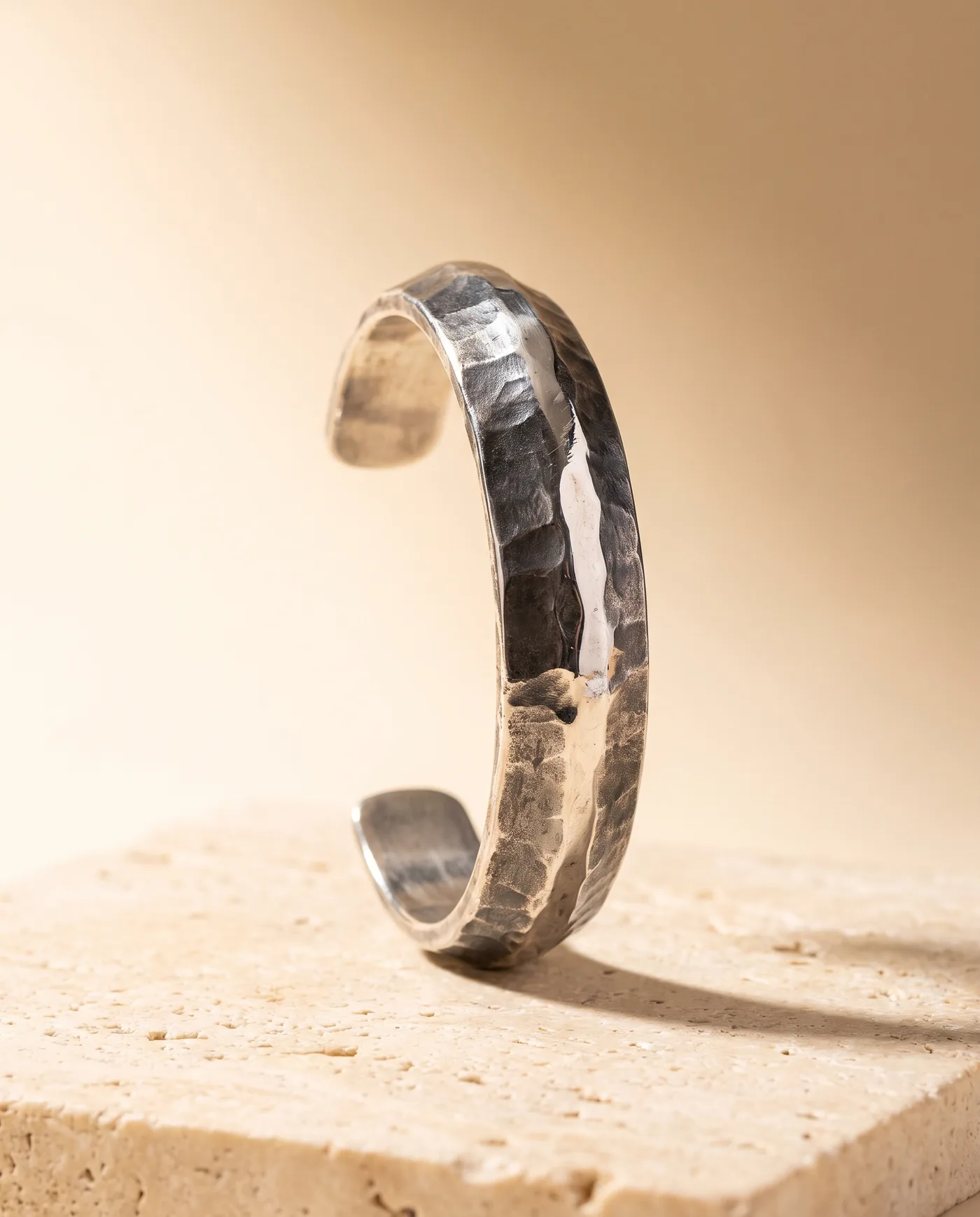
There are two ways to arrive at a piece of jewellery. You can pour molten metal into a mould and clean up what comes out, or you can start with solid stock and work it into shape with hammers, files and saws. The first is casting. The second is fabrication, and where it involves hammer work, forging.
Casting is how the overwhelming majority of jewellery is made, for good reasons: it is fast, it is repeatable, and it makes complex forms trivial. It is also, at a metallurgical level, the weaker option.
What happens inside the metal
When metal cools from liquid, it forms crystals. Cast metal cools relatively slowly and unevenly, producing large grains and — almost always — some porosity: microscopic voids where gas came out of solution and had nowhere to go. You cannot see them. They are there.
Forging does the opposite. Hammering deforms the crystal structure, breaks up the grains, and aligns them along the direction of work. The metal becomes denser, harder and tougher as you go. This is why a forged prong bends before it snaps, and a cast one occasionally just snaps.
Where it shows
In two places, mainly. The first is prongs and claws — the parts under constant load, holding a stone, catching on things. A cast prong with a void near its base is a stone loss waiting for the right knock. The second is thin shanks. A forged band can run to 1.7mm under the finger and stay rigid; a cast one at the same dimension will slowly go out of round.
The difference is invisible on the day you collect the piece. It shows up in year twenty, and again in year fifty.
The honest trade-off
Forging is slower — a shank that takes ninety minutes to cast and finish takes most of a day to forge. It restricts what forms are practical. And it means we cannot make two of anything quickly, which is part of why we do not.
For a piece meant to be worn every day for a lifetime and then handed on, we think it is the only defensible choice. For a piece meant to be worn twice, it would be an extravagance. We only make the first kind.